Designing For Impact
.png)


In today’s planning environment, developers operate under growing scrutiny. Communities are more organised, local authorities are under pressure to evidence real public benefit, and the planning process has become increasingly sensitive to the perceived purpose of development. Against this backdrop, schemes that can demonstrate a credible, well-evidenced social value strategy gain a meaningful advantage.
Whilst great strides have been made to ensure the delivery of social value through the provision of local jobs, training initiatives, educational opportunities and supply chain procurement, designing development to provide social value is often overlooked. Socially responsible, place-specific design ensures value is delivered within communities over the long-term.
Social value is no longer a peripheral consideration; It has become a fundamental strategic tool in shaping planning outcomes. Delivering social value through responsible design, alongside employment, skills and procurement initiatives, maximises the benefit of development, resulting in the creation of prosperous, empowered communities for years to come.
Social Impact as a Strategic Planning Tool
Designing social value into development is increasingly recognised as a core part of creating places that genuinely serve their communities, yet the concept itself only began to gain real prominence in planning discourse in the early 2010s, particularly following the Public Services (Social Value) Act 2012, which elevated the term within public-sector procurement. Since then, “social value” has largely remained framed through the lens of procurement, focused on demonstrating added value through supply chains and employment opportunities. However, in reality, many of the outcomes now being labelled as social value have long been secured through the planning system. Mechanisms such as Section 106 agreements, Community Infrastructure Levy (CIL) contributions, and wider community benefit packages have historically delivered tangible social, economic, and environmental improvements. The challenge and opportunity today lie in moving beyond a procurement-centric definition and embedding social value intentionally and creatively into the design process, the point at which it can have the greatest long-term impact.
In recent years the expectations of planning authorities have evolved. Officers and committees now look for a clear articulation of how a development will actively contribute to local wellbeing, resilience and community cohesion. They expect purpose, not simply mitigation.
By treating social impact as a strategic device, rather than a compliance hurdle, developers can reframe the entire planning conversation. Instead of presenting a scheme that merely avoids harm or satisfies minimum policy requirements, they can demonstrate a proposal that enhances the local area and responds directly to the evidence of need. This shift does more than support policy interpretation; it builds trust, reduces perceived risk and helps decision-makers understand the broader value the project can deliver. When social value becomes integral to the scheme’s identity, it moves the planning balance toward approval by showing not only what the development is, but why it matters. In turn, this improves the commercial viability of development and reduces risk during the planning process.
Understanding the Local Social Characteristics Before Design
Genuine social value begins before any line is drawn on a plan. It begins with a strong understanding of the people, patterns and pressures that shape the local area. A design team that calls upon the advice of a socio-economic experts to analyse demographic data, health outcomes, deprivation indices, mobility behaviours and patterns of social infrastructure use is better equipped to create a scheme that responds to real conditions rather than generic assumptions.
Equally important is the quality of engagement. Traditional consultation often invites communities to comment on pre-determined proposals, which can create tension and distrust. More effective practice involves early conversations with residents, service providers and local businesses, not to seek design instructions but to build a richer understanding of local experience. This fosters transparency and helps identify the issues that genuinely matter, from safety and belonging to affordability and access to green space. It also reduces planning risk, subsequently reducing costs associated with responding to objections and going to appeal.
The insights gathered through this process should be brought together into a clear social value brief that articulates what the community needs and what the development should aim to achieve. When this brief serves as a guiding document for the design team, it anchors the scheme in local reality and ensures it is not just a good project in abstract terms, but an appropriate one for its context, reducing planning risk.
Beyond planning success, there is a growing commercial logic to taking social value seriously. Developments that commit to measurable community benefit tend to move through the planning system more smoothly, face fewer objections and secure stronger political backing. This reduces risk and shortens timelines.
Socially purposeful developments attract tenants, customers and partners more effectively and retain them for longer. They create places that people feel connected to and proud of, which in turn improves occupancy, footfall and value.
Developers who integrate social value into their approach also gain a competitive edge, where credibility and track record in delivering community benefit increasingly influences decision-making. Over time, this approach builds stronger reputational credibility and positions the developer as a trusted partner for local authorities and communities.
Designing With Community Benefit Embedded
Once local needs are well understood, the design stage offers the greatest opportunity to embed community benefit in ways that genuinely shape daily life. Social value cannot be a tokenistic add-on, introduced at a late stage. The most effective projects weave social impact into their architectural logic.
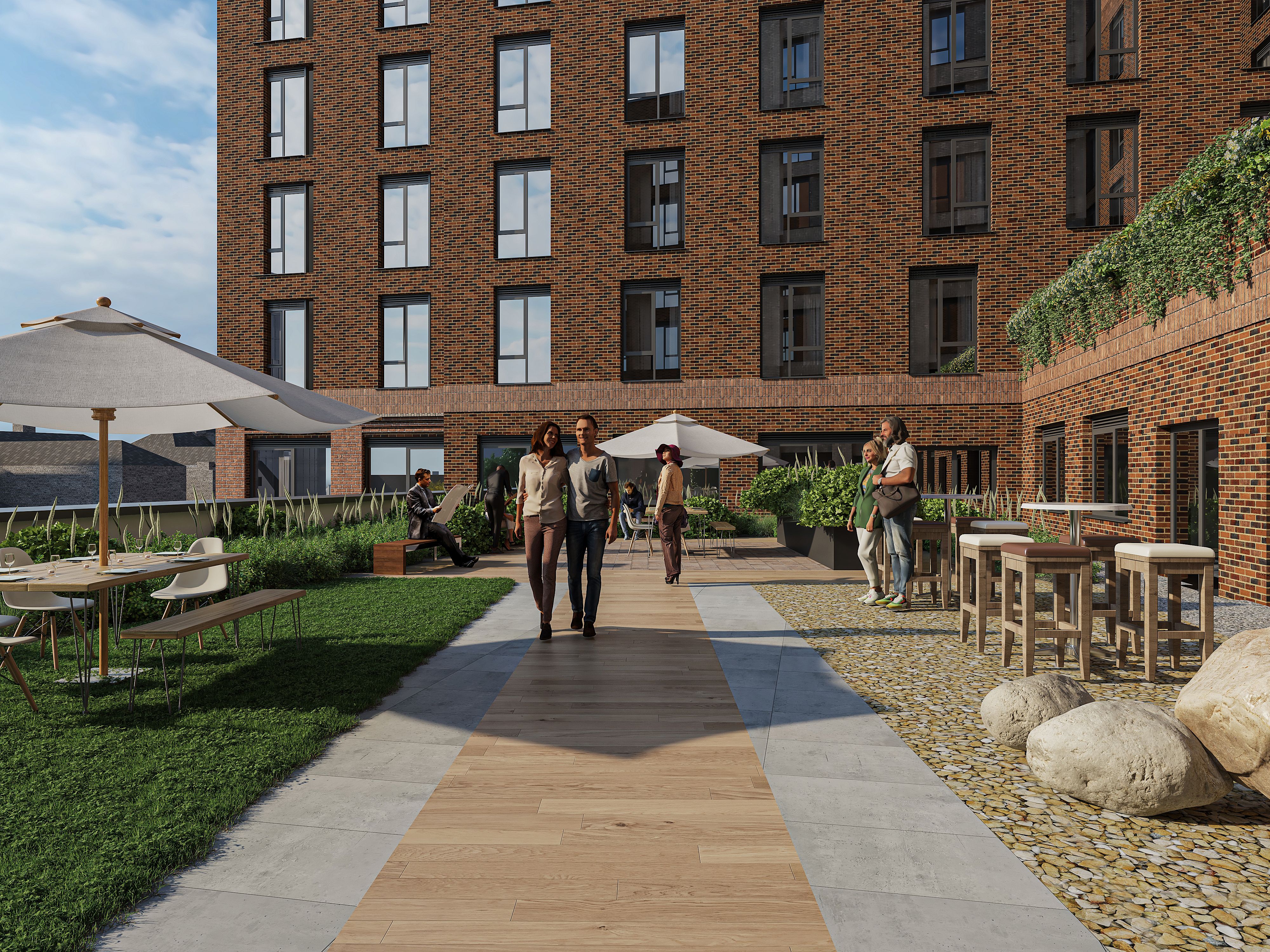
This means designing places that prioritise people’s wellbeing, accessibility, safety and sense of belonging. It means creating adaptable spaces that can serve multiple purposes as community needs evolve, rather than rigid environments that become obsolete. It involves integrating social infrastructure and community-serving uses into the structure of the development itself, so they are part of its identity rather than an optional extra. Thoughtful public realm, inclusive ground-floor uses, active travel networks and health-promoting design principles all contribute to a place where social value is lived, not merely written.
When these elements are embedded from the beginning, they are far more resilient to commercial pressures later on. Social value becomes a core feature of the scheme and part of a narrative that developers, planners and communities can all stand behind.
While narrative matters, evidence is essential. Planning officers and committees increasingly want measurable commitments that demonstrate how proposed social benefits will be delivered and monitored. By using recognised frameworks such as TOMs or Thrive Platform, TRP can quantify a large number of social value design interventions, from new public footpaths to community allotments. This allows developers to express their intentions in quantitative terms that carry weight.
The measurement of social value links design decisions to outcomes. Jobs created, education and skills opportunities provided, local spending commitments, improvements in active travel rates, enhanced access to open space and reductions in carbon emissions can all be forecast with clarity. When these projections are woven into planning documents and quantified using social value frameworks, they allow officers to make more confident recommendations and help committees understand the tangible advantages of the scheme.
Quantification also plays a vital role in addressing objections. Concerns about traffic, service pressure or loss of amenity can be counterbalanced with evidence showing how the development will improve everyday life. When the social value uplift clearly outweighs potential harms, the planning balance shifts in favour of the proposal.
A New Standard for Development Success
The development landscape is undergoing a profound shift. Social value has moved from the margins to the mainstream, becoming a decisive force in planning outcomes and a genuine driver of commercial performance. In this new environment, the most successful developers will be those who act early, those who engage with communities from the outset, who embed social benefit at the heart of design, and who commit to delivering measurable outcomes that matter.
To thrive in a more demanding, more socially conscious era, the industry must embrace models of development that deliver both commercial viability and meaningful social impact. That balance is not only possible, but also increasingly essential.
This is where Third Revolution Projects can make a transformative difference. By supporting developers to unlock viability, we help ensure that schemes can deliver social housing, community infrastructure and wider social value initiatives without compromising commercial returns. Our approach brings clarity to local needs, structure to social value commitments, and confidence to planning negotiations, ultimately enabling developments that secure consent more smoothly and build long-term trust.
Early collaboration between developers, architects and socio-economic consultants is essential; the combined knowledge surrounding design, deliverability and viability allows social value to be embedded in a way that is both meaningful and realistic. When these disciplines work together from the outset, social value is no longer treated as an add-on or a late-stage justification, but as a core part of how a scheme is conceived, shaped and delivered. This creates opportunities to align site layout, land use, phasing, tenure mix, community infrastructure and employment space with identified local needs, while ensuring that commitments remain commercially credible and capable of implementation.
Now is the moment for developers, planners and partners to rethink what their projects can achieve and to work with organisations like Third Revolution Projects to deliver developments that are not only viable, but socially transformative.
If you found the discussion around how social value can be designed into development to create economically and socially viable schemes thought-provoking, please reach out to a Third Revolution team member to discuss how our expertise can propel your proposals forward.
.png)